
Why is the Pantheon called the Pantheon? The simplest answer is that the name comes from Greek and is traditionally connected with the idea of “all the gods”. But the full story is more complex.
We do not know with certainty why this particular building received the name. Even an ancient Roman historian, Cassius Dio, offered more than one explanation: one possibility was that the building contained images of many gods; another connected its rounded form with the heavens.
Modern historians have added further questions. Was the original Pantheon really a temple dedicated equally to every Roman god? Or was it connected more specifically with Augustus, his family and the religious ideas of the new imperial age?
The name has survived for around two thousand years, but its exact meaning still opens a window onto one of the most fascinating questions surrounding the building.
So when someone asks “what does Pantheon mean?”, “all the gods” is a useful first answer. It is not necessarily the final one.
What does the word Pantheon mean?
The Pantheon name is Greek in origin. It is traditionally understood as meaning something like “of all the gods” or “connected with all the gods”.
This is the origin of the familiar English definition “temple of all the gods”. The official heritage authorities in Rome also describe the ancient Pantheon as a temple dedicated to all the gods.
The meaning, however, does not automatically tell us exactly how the building was used. A name can suggest a religious idea without giving us a complete description of the rituals, cults or statues that originally belonged to the building.
So when someone asks “what does Pantheon mean?”, “all the gods” is a useful first answer. It is not necessarily the final one.
Was the Pantheon really a temple to all the gods?
The traditional interpretation describes the Pantheon as a temple of all the gods, and this definition continues to appear in official descriptions of the monument.
Some modern scholars, however, believe the original building may have had a more specific role.
Agrippa constructed the first Pantheon in the Campus Martius during the age of Augustus, between the late 20s BC. The building formed part of a wider monumental programme closely connected with the new political and religious world created after Rome’s civil wars.
Cassius Dio gives an important clue. He says that Agrippa wanted to place a statue of Augustus inside the building and even wanted to give the structure Augustus’ name. Augustus refused. According to the same account, a statue of Julius Caesar was placed inside, while statues of Augustus and Agrippa stood in the entrance area.
This has encouraged some historians to interpret Agrippa’s Pantheon not simply as a universal temple, but as a building connected with the Julio-Claudian family, imperial power and divine associations.
The current official description of the Pantheon also notes a connection with Augustus and the main deities associated with the Julio-Claudian family
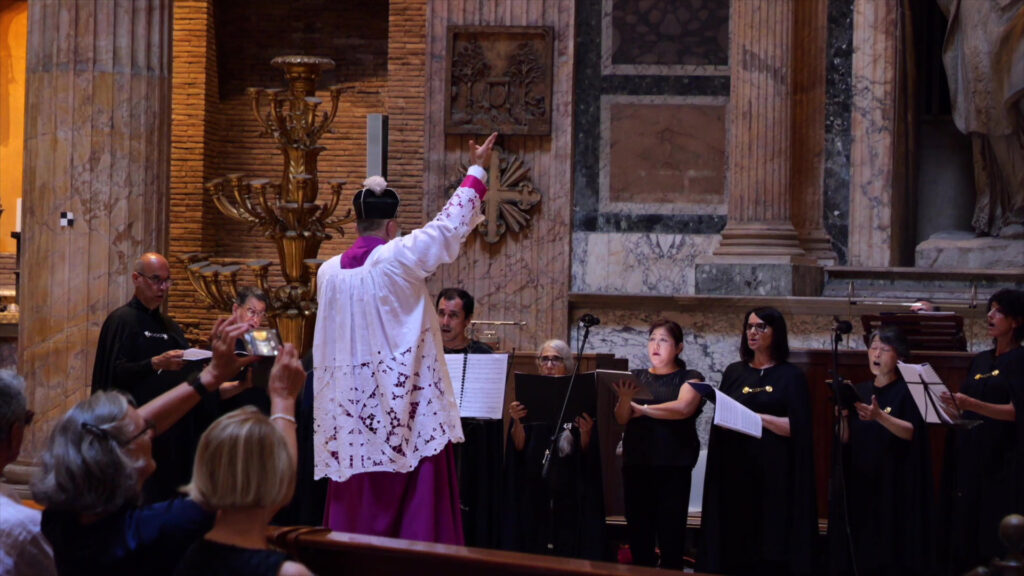
PANTHEON AFTER HOURS
Live the exclusive experience of visiting the Pantheon behind closed doors.
Starting from €27.00
Why was it called the Pantheon?
One of the most important ancient explanations comes from the Roman historian Cassius Dio, who wrote several centuries after Agrippa built the first Pantheon.
Dio says that Marcus Agrippa completed a building “called the Pantheon”. He then offers two possible reasons for the name.
The first is that it contained images of several gods, including Mars and Venus. The second is Dio’s own interpretation: he thought that the building’s rounded roof resembled the heavens.
The important detail is that Dio himself does not present one certain explanation. He uses language of possibility. That uncertainty has remained part of the discussion ever since.
Does Pantheon mean “the heavens”?
Cassius Dio’s second explanation is particularly interesting when you stand inside the Rotunda. He believed the building might have been called the Pantheon because its vaulted roof looked like the heavens.
Inside the present Pantheon, that idea feels immediately understandable.
The circular Rotunda is covered by a vast dome. At its centre, the oculus opens directly to the sky. The interior is about 43.3 metres wide and approximately the same distance from the floor to the top of the dome, creating a space that can be imagined as a sphere.
Light enters through the oculus and moves across the interior during the day. The architecture therefore creates a strong relationship between the enclosed space below and the sky above.
It is easy to understand why an ancient observer could connect this form with the heavens. There is, however, an important historical problem.


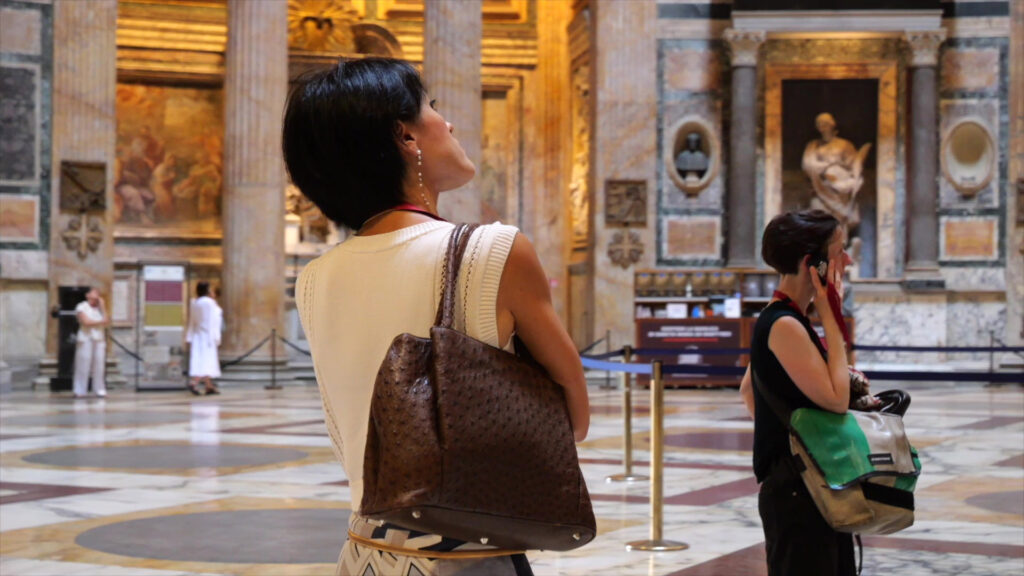
ENTRANCE WITH GUIDED TOUR
Discover our guided tours of the Pantheon in Rome
Starting from €35.00
Agrippa, Augustus and the origin of the name
To understand the origin of the name Pantheon, it helps to return to the first building.
Marcus Vipsanius Agrippa, one of Augustus’ closest collaborators, built the original Pantheon in the Campus Martius in the late first century BC. That building was later damaged and rebuilt. The Pantheon visible today belongs mainly to a major reconstruction carried out during the reign of Emperor Hadrian in the early second century AD.
Yet the memory of Agrippa remained. The famous inscription on the front still reads: M·AGRIPPA·L·F·COS·TERTIVM·FECIT
It records that Marcus Agrippa, son of Lucius and consul for the third time, built the monument. The inscription can be misleading if read without its historical context, because the structure behind it is largely the later imperial reconstruction. But its survival makes an important point: the Hadrianic Pantheon deliberately preserved the memory of the earlier building

The name Pantheon also belonged to that earlier history.
This is one reason why we should be careful when trying to explain the original name only through features of the structure we see today.
Why the Pantheon is it also called Santa Maria ad Martyres?
The meaning of the Pantheon changed dramatically many centuries after Agrippa and Hadrian. In 609, the ancient building was consecrated as a Christian church and received the name Santa Maria ad Martyres, Saint Mary and the Martyrs. This transformation played a major role in the building’s continued use and preservation.
The ancient name did not disappear.
Today the two identities continue to coexist: Pantheon recalls the long Roman history of the building, while Basilica of Santa Maria ad Martyres expresses its identity as a Catholic place of worship that is still active.
This is more than a change of label.
For over fourteen centuries, Christian worship has taken place inside an architecture created in the Roman imperial world. Chapels, altars, tombs and devotional images now share the Rotunda with the ancient dome and oculus.
Understanding the name therefore also means recognising that the Pantheon has never had only one historical identity.
So why is the Pantheon called the Pantheon?
There is no single answer that removes every doubt.
The name is Greek in origin and is most commonly connected with the idea of all the gods. Ancient evidence suggests that the first building contained images of several divinities, including Mars and Venus.
Cassius Dio also proposed another explanation: the rounded form of the building reminded him of the heavens.
Modern research makes the picture more complex. Agrippa’s Pantheon may have been closely connected with Augustus, the Julio-Claudian family and the new religious and political language of the Augustan period, rather than functioning simply as a temple where every Roman god was worshipped equally.
The uncertainty is not a gap that needs to be filled with a legend.
It is part of the history of the Pantheon itself.
When you enter the Basilica of Santa Maria ad Martyres today and look from the ancient walls towards the open oculus, the name still invites the same questions that interested ancient writers: about gods, heaven, power and the meaning of the extraordinary space beneath the dome.
Frequently asked questions about Pantheon history
The standard Pantheon ticket costs €7. An eligible reduced ticket costs €2, while several categories of visitors can enter free of charge.
Not every Sunday. Admission is free for everyone on the first Sunday of each month as part of the Italian Ministry of Culture’s free museum initiative.
Advance booking is optional on normal visiting days. You can also buy tickets on site, but booking in advance can be useful if you want a particular date or time.
Official tickets can be purchased at the on-site ticket offices and automatic ticket machines, subject to availability
Residents of the Municipality of Rome are currently entitled to free admission. Proof of residence may be required.
The official visitor information states that there is no skip-the-line option. An advance ticket reserves your admission for the selected time but does not remove the normal entrance procedures.
- Access for people taking part in religious activities is free. This access is intended for worship and should not be used as an alternative to the normal tourist ticket.
You might also like
All articles ↗
If you have already visited the Colosseum, admired the Sistine Chapel and walked through Rome’s most famous squares, you…
Read article →
Not all of Rome’s hidden churches are found far from the historic centre. Some stand just steps away from…
Read article →
Visiting the Pantheon in Rome is not only about discovering its ancient architecture, monumental dome and famous oculus. Throughout…
Read article →